Youth Lead the Call to End Elephant Rides at Amer Fort on World Environment Day
NewsJoseph Andrew06 Jun 2026
On the occasion of World Environment Day, more than fifty youth gathered at the Jal Mahal in Jaipur to paint wild animals, including elephants, to convey the message that wildlife belongs in the wild The children also delivered spontaneous speeches as part of an extempore event where they highlighted the need to keep all wild animals in the wild, including elephants. It was poignantly brought to the forefront that the captive elephants of Amer Fort in Jaipur are not meant for rides and entertainment, but are suited for a wild existence, where they belong. The children drew images of animals in the wild and in captivity, highlighting the stark contrast of their lives in these situations. The drawings of the children will be delivered to the Chief Minister of Rajasthan requesting him to adhere to the concept of keeping wild animals in the wild on the occasion of World Environment Day and end elephant rides in Amer Fort in Jaipur.
|
|
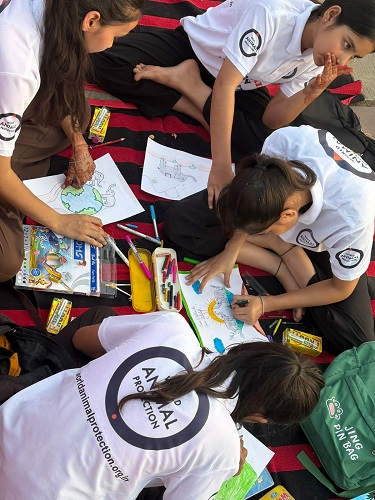
World Environment Day event of World Animal Protection involving youth in Jaipur on 5 June 2026 Photograph : Shubhobroto Ghosh
On World Environment Day, we recognize the vital importance of elephants to the environment. Elephants are vital ecosystem engineers that maintain and regenerate ecosystems through seed dispersal, habitat clearing, and nutrient recycling. By eating, crushing, and moving vegetation, they promote the growth of diverse plant life and capture atmospheric carbon. Elephants consume vast quantities of fruit. As they travel long distances, they deposit these seeds in nutrient-rich dung, effectively planting new forests. Some plant seeds actually require passing through an elephant's digestive tract to germinate. They trample dense brush and eat smaller saplings. This clears competition and opens up canopy gaps, allowing larger trees to absorb more sunlight and store significant amounts of carbon. As they roam, elephants create paths, dig deep wells to tap underground water, and knock down vegetation, providing smaller animals with access to food and water.
Unfortunately elephants are killed for their ivory, become victims of human wildlife conflict and are illegally captured for human entertainment and subject to tortuous training process to make them amenable for rides. Speaking on the occasion, Tricia Croasdell, Chief Executive Officer of World Animal Protection, said, “The event today is an important one for building understanding of how best to protect elephants. Elephants, like all wild animals, are not suited to close, hands-on encounters with people. They belong in the wild, not in captivity or for riding at venues like Amer Fort in Jaipur. Seeing elephants in real life can be a dream come true for many people, but to protect their welfare, we must watch elephants from a distance, in their natural habitat, or at a true sanctuary. I encourage everyone to research before booking elephant activities and spot the signs of elephant exploitation, such as captive breeding and unnatural performances. I am buoyed by the fact that so many children will be involved today, using art and speaking about why we need to 'Keep Wildlife Wild' – a huge thank-you from me for helping to spread this important message.”
Gajender Kumar Sharma, Country Director of World Animal Protection in India, emphasised the importance of keeping elephants wild and not letting them be abused in captivity. “India’s National Heritage Animal belongs in the wild where they are an integral part of the environment. They do not belong in Amer Fort in Jaipur for rides and entertainment. We request the Chief Minister of Rajasthan to listen to the voice of India’s future and end elephant rides in Jaipur and retire the elephants,” he said.
For more information, please contact : Gajender Kumar Sharma, Country Director, World Animal Protection in India
Email : gajenderksharma@worldanimalprotection.org.in
Mobile phone : 9313333283


News
Global Sports Pickleball Announces Season 2 Pro & Challenger League Auction in Mumbai
News
Celonis Climbs Forbes 2025 Cloud 100 List as Demand Grows for Process Intelligence in the AI Era

News
Dr. Bhargav Mallappa’s Malaysia Visit Marked by Meeting with Prince Dato’ Seri Dr. Christian Kingsley Goh Kwee Keng JP
News