EducationK Puspa27 Nov 2026
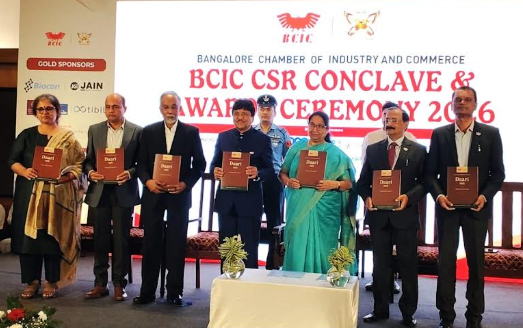
Bengaluru, Nov 27: CSR should not be undertaken merely because it is a statutory obligation, but with a sense of responsibility towards the society from which we have received so much. While we speak of women's empowerment and healthcare, several rural schools still lack basic sanitation facilities for girl students and women teachers. I urge the industry to develop a comprehensive roadmap to address such challenges across Karnataka. Corporates must see their CSR projects through to completion and periodically assess their impact rather than merely disburse funds. Such sustained and collective efforts will make a meaningful contribution towards the vision of Viksit Bharat 2047,” said Dr. Sudha Yadav, Honourable Governor of Karnataka, who was a Chief Guest at the maiden CSR Conclave and Awards Ceremony organised by the Bangalore Chamber of Industry and Commerce .
While addressing the gathering, Dr. Sudha Yadav called upon industries to develop a comprehensive CSR roadmap to address these challenges through sustained interventions. Recalling her visit to a tribal village in Chitradurga district, Dr. Yadav highlighted the gaps in access to education and basic amenities in remote communities. She also called for greater accountability in plantation initiatives, stressing that their success should be measured by the survival of saplings rather than the number planted.
Delivering the welcome address, CA K. Ravi, President, BCIC, said,
“CSR has evolved from cheque-book philanthropy into strategic, measurable and boardroom-driven nation-building. As BCIC celebrates its Golden Jubilee, our initiatives in preventive healthcare, community-led urban development and environmental sustainability reflect our commitment to moving beyond compliance and creating lasting grassroots impact through active industry participation.”
Announcing three major CSR initiatives as part of BCIC's Golden Jubilee celebrations, CA Ravi said the Chamber would partner with Sri Shankara Cancer Foundation to conduct cancer awareness programmes across 10 schools and 10 colleges, reaching approximately 4,000 students. The programmes will focus on prevention, early warning signs, healthy lifestyles and timely diagnosis. In association with Volvo Group's Wellness on Wheels initiative, BCIC will also facilitate preventive heart and cancer screening for an initial 500 beneficiaries from underprivileged communities across Karnataka.
BCIC also announced the launch of the Ward Impact Lab, with Ethos Foundation as its knowledge partner and support from the Greater Bengaluru Authority. The initiative will bring together architects, urban designers, planners and residents to develop ward-specific interventions through mapping, community walks and collaborative design. These interventions will be showcased publicly to attract CSR funding for implementation. Further, BCIC will undertake the plantation of 10,000 saplings across Bengaluru and Mysuru over the next year.
Delivering the keynote address, Mr. S. D. Shibulal, Co-founder and Former CEO, Infosys, urged corporates to move beyond statutory compliance and short-term CSR projects towards long-term commitments, leveraging their technology, management expertise, innovation and institutional capabilities. Emphasising that a developed India cannot be built on islands of excellence surrounded by gaps in opportunity, he said Bengaluru's prosperity must translate into opportunities for the rest of Karnataka.
60-70% of Karnataka's CSR Expenditure Concentrated in Bengaluru
Highlighting the growth in CSR investments, Mr. G. V. Rao, Chairman, CSR Expert Committee, BCIC, said annual CSR expenditure in India had increased fourfold from approximately ₹ 10,000 crore in FY 2014-15 to ₹ 40,800 crore in FY 2024-25. Cumulatively, Indian industry has invested over ₹ 2.6 lakh crore in social development since the introduction of the CSR mandate in 2014, with education and healthcare accounting for more than half of the national allocation.
Karnataka has witnessed an over eightfold increase in annual CSR funding, emerging as the third-largest recipient in the country and accounting for nearly 8.3 per cent of national CSR expenditure.
“Nearly 60–70 per cent of Karnataka's CSR expenditure is concentrated in Bengaluru Urban and Rural districts, with a significant share of the remaining funds going to urban centres such as Mysuru, Hubballi-Dharwad and Mangaluru. Very little reaches rural Karnataka and underserved regions such as Kittur Karnataka and Kalyana Karnataka. I urge the CSR fraternity to look beyond Bengaluru and direct resources towards communities where the need and potential for social impact are much greater,” Mr. Rao said.
BCIC Recognises Excellence in CSR
Dr. BS Srinath, Managing Trustee, Sri Shankara Cancer Foundation and Head of Institutions-Sri Shankara Cancer Hospital and Research Centre presented the BCIC CSR Awards to corporates and non-profit organisations for their contributions across five key areas of social development. In the Education category, Sansera Engineering Limited and Bangalore International Airport Limited emerged as joint winners, while Akshara Foundation won in the non-profit segment. In Healthcare, Biocon Foundation bagged the corporate award, while Indian Cancer Society and Centre for Cellular and Molecular Platforms were declared joint winners in the non-profit segment. Tamara Leisure Experiences Pvt. Ltd. won in the Environment category, while The Karur Vysya Bank Limited secured the award for Skilling and Livelihood. Sahyadri Community Development and Women Empowerment Society won in both these categories under the non-profit segment. TVS Srinivasan Services Trust received the award for Women Empowerment.
The conclave featured three panel discussions on ‘The Evolving Boardroom Agenda: CSR, Governance and Sustainability,’ ‘Education & Skilling for a Resurgent Karnataka,’ and ‘CSR for Making Karnataka Inclusive, Resilient and Prosperous.’ The sessions brought together corporate leaders, CSR practitioners, education experts and representatives of civil society to deliberate on industry-led interventions for Karnataka's socio-economic development.
Education

Education

Education
Education