Japan Shifts to Active Defense in Economic Security, Expanding Regulatory Powers
BusinessNeel Achary04 Jun 2026
Analysis: Japan's Economic Security State Enters a New Phase
Japan's economic security agenda is undergoing a significant transformation, marking a shift from defensive supply chain protection toward a more comprehensive national security framework that places strategic industries, technology, data, and foreign investment under closer government scrutiny.
A series of legislative initiatives advancing through Tokyo in 2026 suggest that economic security is no longer being treated as a niche policy concern. Instead, it is becoming a central pillar of Japan's national strategy, reflecting broader geopolitical tensions, intensifying technological competition, and growing concerns about vulnerabilities in critical infrastructure.
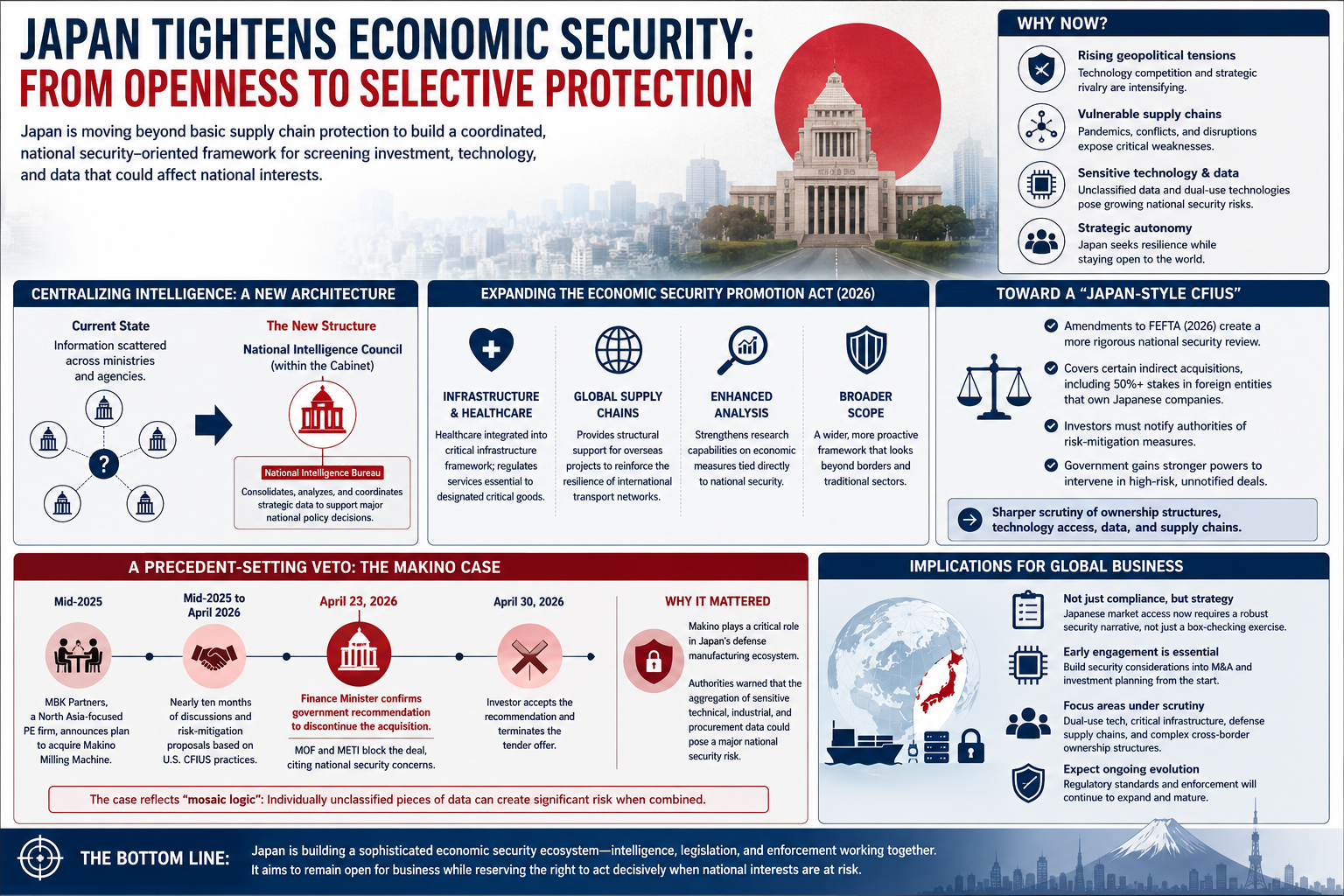
Building a Centralized Intelligence Architecture
One of the most consequential developments is the proposal to establish a National Intelligence Council within the Cabinet. The initiative would create a more centralized intelligence structure capable of supporting strategic decision-making across government.
The accompanying National Intelligence Bureau would consolidate information currently dispersed among ministries and agencies, potentially giving policymakers a more integrated view of emerging security threats. For Japan, which has traditionally relied on fragmented bureaucratic structures, the move represents a notable institutional shift toward coordinated intelligence gathering and analysis.
The proposal also reflects a growing recognition that economic security threats often emerge from complex intersections of technology, trade, investment, and supply chains rather than from conventional military channels alone.
Expanding the Scope of Economic Security
The amendments to the Economic Security Promotion Act demonstrate how broadly Tokyo now defines national security.
By incorporating healthcare into the critical infrastructure framework and extending support to overseas projects that strengthen global transportation networks, the government is expanding its focus beyond traditional defense sectors. This approach acknowledges that disruptions to medical systems, logistics routes, or industrial supply chains can have strategic consequences comparable to more conventional security threats.
The legislation also strengthens analytical capabilities related to economic measures tied to national security, signaling an effort to improve the government's ability to identify and respond to emerging vulnerabilities before they become crises.
Toward a More Assertive Investment Screening Regime
Perhaps the most significant change for international businesses is the evolution of Japan's foreign investment review system.
Through amendments to the Foreign Exchange and Foreign Trade Act (FEFTA), Tokyo is effectively creating a more robust screening mechanism that increasingly resembles the role played by the Committee on Foreign Investment in the United States (CFIUS). While Japan is not establishing a separate agency, the practical effect is similar: greater scrutiny of foreign investments that may affect national security interests.
The expanded rules covering indirect acquisitions illustrate the government's determination to close potential regulatory gaps. Foreign investors will also face greater obligations to demonstrate how they intend to mitigate security risks, while authorities gain broader powers to intervene in transactions that are deemed problematic.
The message is clear: ownership structures, data access, and technological capabilities will be examined more carefully than ever before.
The Makino Decision Signals a New Regulatory Reality
The government's intervention in the proposed acquisition of Makino Milling Machine by MBK Partners provides the clearest indication yet of how this evolving framework will operate in practice.
Despite extended negotiations and proposed mitigation measures, Japanese authorities concluded that Makino's importance to the country's defense manufacturing ecosystem outweighed the benefits of the transaction. The decision demonstrates a willingness to block deals even when investors attempt to address government concerns through established international best practices.
More importantly, the case highlights Japan's growing acceptance of what security experts describe as "mosaic theory" or "mosaic logic." Under this approach, seemingly harmless pieces of information may become strategically sensitive when combined with other data sets. As a result, regulators are increasingly concerned not only with direct technology transfers but also with indirect access to industrial knowledge, procurement networks, and customer relationships.
Implications for Global Investors
For multinational corporations and private equity firms, Japan's evolving regulatory environment represents a fundamental change in how cross-border transactions must be approached.
Traditional compliance exercises are unlikely to be sufficient. Investors will increasingly need to develop comprehensive security narratives that explain how transactions align with Japan's national interests, protect sensitive technologies, and safeguard critical industrial capabilities.
This trend mirrors developments across other advanced economies, where governments are placing greater emphasis on economic resilience, technological sovereignty, and strategic autonomy. However, Japan's approach is distinctive because it seeks to maintain an open investment environment while simultaneously applying more targeted and sophisticated security screening.
The challenge for policymakers will be maintaining that balance. Excessive restrictions could discourage foreign investment and innovation, while insufficient oversight could expose critical sectors to strategic risks.
As the new legislation advances and enforcement actions become more common, Japan appears determined to pursue a middle path: remaining open to international business while reserving the right to intervene when economic activity intersects with national security concerns. The result is likely to be a more selective, intelligence-driven investment environment that reshapes how global companies engage with one of Asia's largest economies.