Scientists Achieve the First Total Synthesis of Complex Alkaloids Isolated from Plants
NewsNeel Achary08 Jun 2026
Chiba, Japan, June 8, 2026: Researchers at Chiba University have achieved a significant breakthrough in medicinal chemistry by developing an innovative strategy to synthesize complex plant-derived alkaloids that could pave the way for next-generation cancer treatments.
The research team, led by Professor Hayato Ishikawa of the Graduate School of Pharmaceutical Sciences at Chiba University, successfully developed a novel synthetic route for producing bisleuconothine A and bousigonine B—two highly complex monoterpenoid indole alkaloids (MIAs) known for their promising pharmaceutical properties.
The findings, published in Angewandte Chemie International Edition, address a longstanding challenge in drug discovery. Although many plant-derived alkaloids possess potent biological activity, their intricate molecular structures have made laboratory synthesis extremely difficult, limiting further research and therapeutic development.
Among these compounds, bisleuconothine A has attracted particular attention due to its demonstrated activity against breast and lung cancer cells. Scientists believe that its unique three-dimensional structure enables it to interact with biological targets that are often inaccessible to conventional small-molecule drugs.
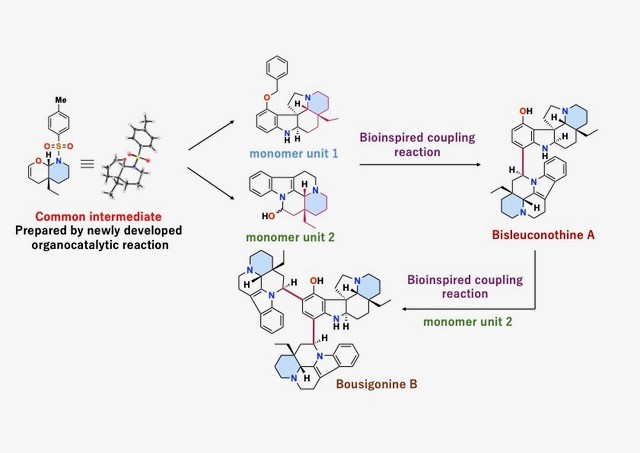
To overcome the synthesis challenge, the Chiba University team designed a new organocatalytic cascade reaction capable of efficiently constructing a critical 3-ethylpiperidine scaffold found in numerous indole alkaloids. The process generated a highly pure intermediate that served as a versatile building block for assembling more complex molecular structures.
Using this common intermediate, researchers created two distinct alkaloid fragments and subsequently linked them through a bioinspired coupling reaction that mirrors the natural processes used by plants to produce these compounds. The strategy enabled the synthesis of bisleuconothine A in 20 steps and resulted in the first-ever total synthesis of bousigonine B.
“The present method for total chemical synthesis is expected to facilitate the development of new pharmaceutical agents,” said Professor Ishikawa. “In particular, bisleuconothine A has exhibited potent anticancer activity, highlighting its potential as a lead compound for anticancer drug development.”
Beyond these two molecules, the researchers believe their methodology could provide a broader platform for synthesizing other structurally complex natural products. By enabling more efficient access to rare alkaloids, the approach may accelerate drug discovery efforts across oncology and other therapeutic areas.
The team is now focused on expanding the technique to synthesize additional members of the MIA family and evaluating their biological activity for potential pharmaceutical applications.
The study received support from the Japan Society for the Promotion of Science (JSPS), the Ministry of Education, Culture, Sports, Science and Technology of Japan, and the JST SPRING program.
The breakthrough marks an important step toward unlocking the therapeutic potential of nature’s most complex molecules and could open new avenues for the development of innovative anticancer medicines.