India's Fight Against Sickle Cell Disease Needs More Than Screening: National Stakeholders Chart Roadmap to 2047
HealthK Puspa28 Sept 2026
New Delhi, Sep 28: India has screened more than seven crore people for sickle cell disease and reported about 2.5 lakh cases, along with roughly 20 lakh carriers. At a national roundtable in the capital, doctors, scientists, patient advocates and public health experts agreed that the harder task begins after a positive result: keeping patients connected to treatment, follow-up and, where suitable, transplant.
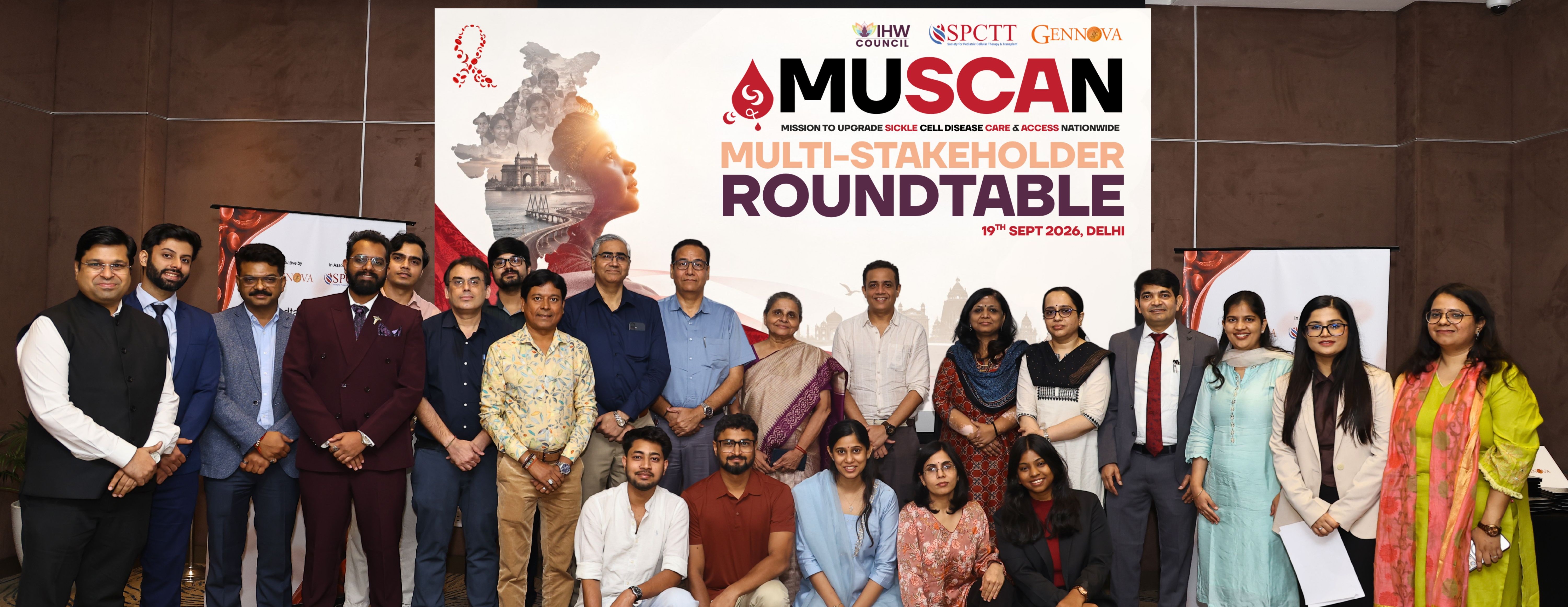
The meeting was hosted by Integrated Health & Wellbeing Council in association with The Society for Pediatric Cellular Therapy and Transplant under MUSCAN, an initiative of Gennova Biopharmaceuticals Ltd. It was described as the first in a series of larger healthcare system strengthening projects. Participants included representatives of government agencies, clinicians from government and private institutions, scientists, medical associations like SPCTT and Pediatric Hematology Oncology Chapter of the Indian Academy of Pediatrics and patient organisations including Network Alliance of Sickle Cell Organisations, Sickle Cell Foundation of Chhattisgarh.
Where Patients Are Lost
Mr Kammal Ssahu, President of the Sickle Cell Foundation, Chhattisgarh, and member of NASCO, a Sickle Cell Disease warrior himself, while elaborating his journey highlighted that samples are often collected in villages but results reach the health facility rather than the family. Many families never return for confirmation, and patients drop out of view as they move from primary health centres to district hospitals and medical colleges, with no way to trace them. He also pointed to hydroxyurea stock-outs in some tribal districts and long journeys for short refills.
"A sample is collected in the village, but the result reaches the facility and not the family. Unless someone is made responsible for telling the family and bringing them back, we will keep losing patients between the screening camp and the clinic." Mr Kammal Ssahu
Dr. Dipty Jain urged care in reading the national numbers. Around half of reported cases come from a few states, and it is unclear how much that reflects true burden and how much reflects differences in screening methods. Phase 1 data, she said, should not be used alone to estimate burden. The next phase is expected to add antenatal and newborn screening.
Ideas on the table included a unique patient ID linked to the ABHA health account, missed-call or SMS refill reminders, village-level medicine depots, tele-consultation and a bigger role for ASHA workers. Programme guidelines already call for SCD services at primary and community health centres, not only district hospitals.
"Sickle cell work in India has so far proceeded in compartments: screening, prevention, care and transplant. This roundtable was about bringing those compartments together." Dr Gaurav Kharya
Care First, Then Cure
Clinicians stressed that SCD care should not wait for a crisis. Hydroxyurea works best when dosed and monitored for each patient, transfusions should follow clear indications, and vaccination and organ checks should be routine.
Haematopoietic stem cell transplantation remains the only established cure available in India. Indian centres like FMRI, Gurgaon and Apollo Hospitals, Delhi presented encouraging results, particularly with matched sibling donors and treosulfan based conditioning regimens, though these come from individual centres with limited follow-up. Speakers said outcomes are better when patients are referred young, before organ damage sets in, yet most reach transplant centres after the age of 10. SPCTT presented 14 evidence-based recommendations on when to consider transplant, developed over about a year by a national and international panel with participation from ICMR and NASCO. The HSCT for SCD Guidelines from SPCTT would be available for reference soon.
"Our aim is to help families and doctors decide, on evidence, who should be considered for transplant and when. Referral before organ damage sets in changes outcomes." Dr S. P. Yadav
Gene therapy drew optimism and caution in equal measure. Experts suggested that cost, manufacturing capacity, regulation and trained centres must be planned early, and that any future therapy will reach patients only if the basics work first.
Funding: The Missing Link
Participants agreed that the mission cannot be delivered on a screening budget alone. Routine care needs dependable financing for medicines, vaccines and safe blood, village-level supply points, digital patient tracking and training for frontline doctors.
On transplant, support exists but few families know about it. Figures cited at the meeting included a prenatal testing package of up to ₹15,000 under Ayushman Bharat PM-JAY and transplant support of up to ₹15 lakh under Rashtriya Arogya Nidhi scheme, subject to BPL documentation, alongside some state schemes. Participants proposed a verified guide to central, state and CSR support, with help desks to guide families through the paperwork. Participants called for public-sector capacity backed by financing, so that access to a cure does not widen existing gaps.
What Happens Next
Agreed follow-ups include publication of the HSCT for SCD SPCTT Guidelines, an online SCD certification course for paediatricians and physicians modelled on an existing thalassaemia programme, and further regional meetings with local clinicians and patient groups. Dates have not been announced.
Introducing MUSCAN, Dr Raonak Karnde, Cluster Medical Lead of Gennova Biopharmaceuticals Ltd, who also moderated the panel discussion, described it as a shared platform for the whole sickle cell community.
"MUSCAN is meant to be one table where government, clinicians, scientists and patients work on the same problem. This is the first of a series, and the aim is practical, action-oriented solutions for patients and health systems." Dr Raonak Karnde
The National Sickle Cell Anaemia Elimination Mission was launched by Prime Minister Narendra Modi from Shahdol, Madhya Pradesh, on July 1, 2023, with the goal of eliminating SCD as a public health problem by 2047.