Trade Unions and Italian Industry’s demands to Europe
BusinessNeel Achary24 Apr 2026
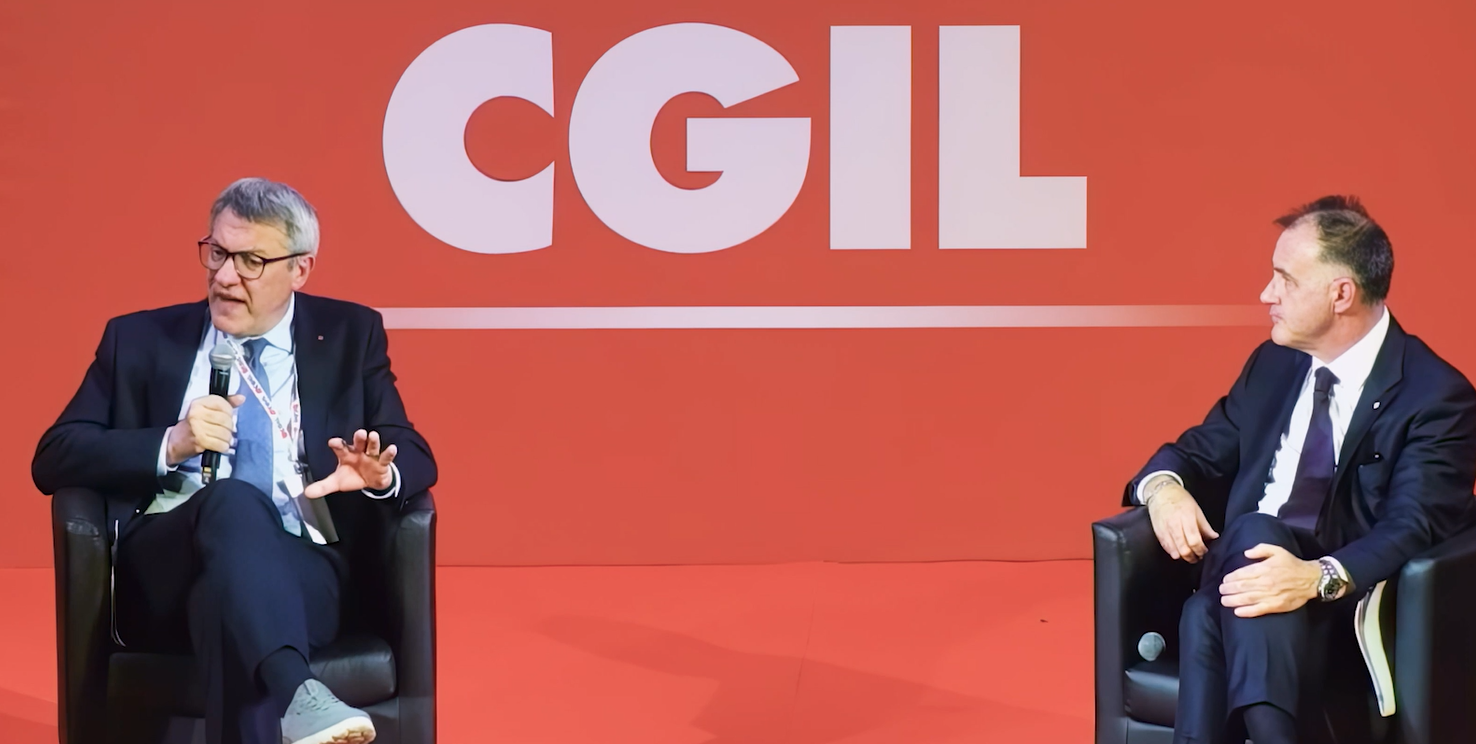
The Secretary of CGIL, Italy’s main trade union, Maurizio Landini, and the President of Confindustria, Emanuele Orsini, discuss the future of Italian industry.
On 23 April, the National Assembly of delegates from CGIL’s industrial sectors—Italy’s leading trade union—took place in Rome, focusing on the future of the country’s production system amid an economic slowdown, ongoing industrial transitions and rising international tensions.
The central moment was the discussion between Maurizio Landini, General Secretary of CGIL, and the President of Confindustria Emanuele Orsini representing Italy’s leading association of manufacturing and service companies. The debate highlighted a shared assessment of the critical nature of the current context, though with differing emphases on the solutions.
Energy has once again emerged as the most pressing issue for the industrial system. Costs in Italy remain above the European average, directly impacting the competitiveness of manufacturing companies—particularly in energy-intensive sectors. Both sides underscored the urgency of structural measures that can no longer be delayed.
At the macroeconomic and European level, Maurizio Landini identified the suspension of the Stability Pact as a priority, arguing for the need to free up resources for public investment in industry, innovation and employment. This position forms part of a broader critique of the lack of a coherent national industrial policy, seen as one of the factors weakening Italy’s production system.
The discussion also addressed the role of the European Union, which — according to the debate — must strengthen common instruments to support industrial transition, starting with energy, technologies and strategic supply chains, in a context of increasingly intense global competition.
A further point raised by Maurizio Landini and Emanuele Orsini concerns the need for Europe to move towards the creation of new common debt, which currently remains lower than that of the United States. The strength of the euro against the dollar, in fact, places European companies at a disadvantage, to an even greater extent than tariffs.
The debate also touched on the role of Chinese industry and what was described as unfair competition towards European companies. Here too, Europe is called upon to act in order to safeguard the Continent’s productive capacity.
Another key issue was investment. Italy’s ability to attract capital and strengthen its production chains was identified as essential to preventing a gradual industrial decline. In this context, the need for closer coordination between national and European policies clearly emerged.
The discussion outlined a scenario of significant concern regarding the trajectory of the Italian economy, with the risk — highlighted during the debate — of a period of stagnation if adequate public and industrial measures are not implemented swiftly.