India’s Semiconductor Moment: How Chips, AI and Manufacturing Are Reshaping the Next Growth Story
BusinessBhumika Lenka17 Sept 2026
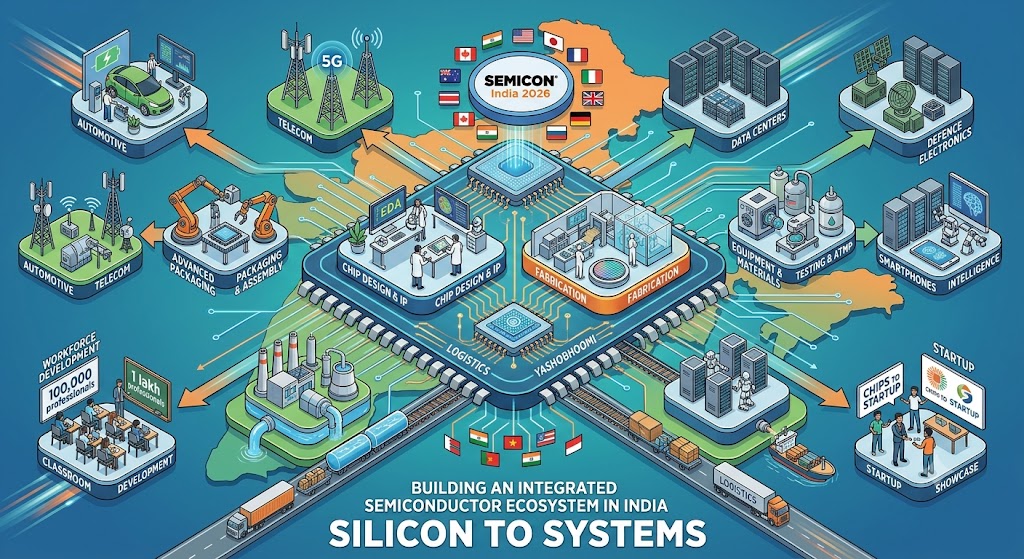
India’s semiconductor ambitions are entering a more decisive phase. The country is no longer looking at chips only through the lens of technology imports or electronics assembly. The bigger objective is to build an integrated semiconductor ecosystem in India that connects chip design, fabrication, advanced packaging, equipment, materials, research, artificial intelligence and electronics manufacturing.
That transition is at the centre of SEMICON India 2026, being held from September 17 to 19 at Yashobhoomi in New Delhi. The fifth edition has brought together more than 600 exhibitors, including around 300 international companies, along with policymakers, investors, researchers, startups and technology companies. The event is being organised around the theme “Silicon to Systems: Building the Ecosystem”, signalling a broader ambition that goes beyond manufacturing individual semiconductor components.
For India, the timing is significant. Semiconductors have become foundational to automobiles, smartphones, telecommunications, data centres, industrial automation, defence electronics and artificial intelligence. As these industries become increasingly dependent on advanced computing, access to reliable semiconductor supply chains is becoming an important part of industrial competitiveness.
From chip manufacturing to a complete semiconductor value chain
The central challenge for India is not simply to establish semiconductor fabrication plants. A competitive semiconductor manufacturing ecosystem requires a much wider network of suppliers, engineers, equipment makers, testing facilities, design companies, research institutions and logistics providers.
That is why the current semiconductor strategy is increasingly focused on the complete value chain. Chip design and intellectual property sit at one end, while fabrication, assembly, testing, packaging and end-use electronics sit at the other. Between them lies an extensive industrial network involving semiconductor equipment, specialty chemicals, materials, software and precision engineering.
The significance of SEMICON India 2026 lies partly in bringing these different segments together. The exhibition includes country and state pavilions, a startup showcase, workforce-development initiatives and discussions around AI, advanced packaging, semiconductor materials, chip design, supply-chain resilience, research and development and high-performance computing.
This creates opportunities well beyond large chip manufacturers. Indian engineering companies, electronics manufacturers, logistics firms, software businesses and specialised MSMEs can potentially become part of the emerging semiconductor supply chain.
Semicon 2.0 raises the ambition
The next stage of India's semiconductor policy is being shaped by Semicon 2.0, which expands the focus from individual projects towards ecosystem development.
The initiative is designed around areas including chip design, semiconductor equipment and materials, fabrication, assembly and testing, research and development and talent. Industry discussions around the programme have also highlighted ambitions to support at least 200 chip-design companies and build a pool of around one lakh semiconductor technicians and industry-ready professionals.
The scale of the programme reflects a basic reality of the semiconductor industry: manufacturing capacity cannot remain isolated from design and innovation.
A country may build fabrication facilities, but sustained competitiveness also depends on whether domestic companies can develop intellectual property, design specialised chips, manufacture supporting equipment and provide engineering services.
That is where the economic opportunity becomes considerably larger.
Why semiconductors matter to India’s manufacturing economy
The semiconductor industry has a multiplier effect because chips are embedded in so many modern products.
Automobiles increasingly rely on electronic control units, sensors and power-management chips. Telecommunications networks require sophisticated processors and communication components. Data centres depend on high-performance computing hardware, while AI applications are creating new demand for specialised processors and memory technologies.
A stronger domestic semiconductor industry could therefore support growth across electronics manufacturing in India, automotive technology, telecommunications, industrial machinery and consumer devices.
For manufacturers, greater access to domestic components could also improve supply-chain resilience. For technology startups, the opportunity could emerge in areas such as chip design, electronic design automation, testing, embedded systems and semiconductor software.
The resulting ecosystem could create business opportunities not only for multinational corporations but also for Indian startups, MSMEs and specialised engineering companies.
India’s chip-design capability is gaining depth
Manufacturing is only one part of the semiconductor story. India has historically had a strong presence in chip design and engineering services, and the policy focus is increasingly aimed at converting that talent base into a broader domestic semiconductor industry.
Under the Chips to Startup programme, electronic design automation tools have been made available across hundreds of academic institutions, while tens of thousands of students have received semiconductor design training. By April 2026, 211 chips had been taped out by 75 institutions, with several reaching fabrication at different technology nodes.
These efforts matter because semiconductor competitiveness is ultimately built on specialised knowledge. The ability to design chips, verify them, develop intellectual property and connect designs with manufacturing can create a stronger foundation for future Indian semiconductor companies.
AI is changing the semiconductor opportunity
The rapid expansion of artificial intelligence is adding another dimension to India’s semiconductor ambitions.
AI models require substantial computing power, and that translates into demand for advanced processors, accelerators, memory and networking technologies. As Indian businesses increase their use of AI and data centres expand, the demand for computing infrastructure is likely to become increasingly important.
This creates an opportunity to connect AI in India with the domestic semiconductor ecosystem. Instead of viewing AI and chip manufacturing as separate industries, companies can increasingly operate across the hardware-software boundary.
For India, the combination of semiconductor manufacturing, AI, data centres and electronics could create new investment opportunities across the technology value chain.
Infrastructure and logistics will be equally important
Semiconductor manufacturing is among the most infrastructure-intensive forms of advanced manufacturing. Reliable electricity, high-quality water, specialised industrial infrastructure and efficient logistics are critical to maintaining production standards.
This makes India's broader infrastructure expansion relevant to the semiconductor story.
Ports, airports, highways, freight corridors and industrial clusters influence the cost and speed at which high-value components move through supply chains. A semiconductor ecosystem therefore needs more than factories; it requires an industrial environment capable of supporting time-sensitive and technically demanding production.
For businesses, better connectivity can reduce logistical friction while helping manufacturers integrate Indian operations with international supply chains.
Global companies are becoming part of the conversation
SEMICON India 2026 also demonstrates the international dimension of India’s semiconductor ambitions. More than 300 international companies are participating, with delegations from dozens of countries. The event includes six country pavilions and 12 state pavilions, creating a platform for technology partnerships, investment discussions and supply-chain collaboration.
Global semiconductor companies are evaluating India not simply as a large consumer market but also as a potential manufacturing, design and engineering base.
That distinction is important. If India can move further up the semiconductor value chain, the country could participate more deeply in global electronics production rather than primarily importing critical components.
The shift from announcements to execution
India’s semiconductor programme is also beginning to show signs of moving from policy design towards commercial activity.
Of the 12 projects approved under the first phase of the Semicon India Programme, three have already commenced commercial production, according to information released ahead of SEMICON India 2026. The approved projects represent more than Rs 1.64 lakh crore in investment commitments across areas including semiconductor fabrication, compound semiconductors, display fabrication and advanced packaging.
This transition is important because the success of India's semiconductor strategy will ultimately depend on execution.
Factories need to reach commercial scale. Suppliers need to emerge around them. Skilled workers need to be available. Indian companies need to develop competitive products, while global firms need confidence that the ecosystem can support long-term operations.
The business opportunity goes beyond the chip
The most significant economic impact of India’s semiconductor push may ultimately come from the industries surrounding the chip.
A growing semiconductor ecosystem can create demand for precision machinery, industrial automation, chemicals, clean-room technology, testing equipment, software, engineering services, logistics and technical maintenance. It can also stimulate research partnerships between universities, startups and manufacturers.
For MSMEs, this creates an opportunity to enter specialised niches instead of competing directly with large semiconductor manufacturers.
For investors, the opportunity extends across the wider electronics and technology supply chain.
For policymakers, the challenge will be to ensure that incentives and infrastructure translate into commercially sustainable businesses and deeper domestic value addition.
India’s semiconductor story is becoming an industrial story
The significance of SEMICON India 2026 therefore extends beyond the semiconductor sector. It reflects a broader change in India's industrial strategy, where technology manufacturing, AI, electronics, infrastructure, logistics and skilled talent are increasingly being developed as interconnected parts of the economy.
The country’s semiconductor journey has moved considerably beyond the idea of simply making chips domestically. The larger objective is to build capabilities across the value chain — from chip design and semiconductor fabrication to advanced packaging, testing, equipment, materials and end-use electronics.
The next phase will be judged by how effectively these capabilities connect with one another.
If India can build that depth, semiconductors could become more than a strategic technology sector. They could form part of a broader manufacturing engine, creating opportunities for global companies, Indian enterprises, startups, MSMEs, engineers and technology professionals.
That is ultimately what makes the current semiconductor push significant: the opportunity is not merely to manufacture more chips, but to build an industrial ecosystem around them.