BusinessManasi Praharaj21 Nov 2026
Kolkata, November 21, 2026: Lambda Quantitative Strategies Association (LAQSA), India’s first and only quant community, found a new home in the east as it successfully concluded the seventh edition of the Indian Institutional Quant Conference (IIQC) at The Park, Kolkata, on November 20. Following editions in Delhi, Mumbai and Bengaluru, the conference’s first outing in eastern India brought together practitioners, researchers and leaders from Asset Management Companies (AMCs), family offices, broking houses, technology firms and educational institutes for a day of panel discussions and fireside chats.
Nuvama Asset Services returned as title sponsor, supported by BSE as gold sponsor, Levitas Trade LLP as silver sponsor, and V Mathran & Co Pvt Ltd and ICICI Exchange Traded Funds as bronze sponsors.
The day’s defining conversation was the fireside chat “Can Next Decade of Quant Belong to India - Enablers vs Hurdles and Global Learnings”, moderated by Rishi Kohli (Chief Investment Officer - JioBlackRock AMC and Co-Founder, LAQSA). Pankaj Mani (Global Quant & Risk Advisor, Co-Founder- LAQSA, Research Author - World’s Prestigious Wilmott Magazine, RealWorldRisk) spoke of the significant opportunity ahead, noting that India’s quant ecosystem, while still young, has ample room to grow and rise to global standards. Quant, he said, is a broad, scientific discipline rooted in Brownian motion, spanning portfolio, risk and performance analysis, and far more than data alone.
Sandip Biswas (Director, Principal Financial Engineer, BlackRock) underlined the importance of empirical testing, pointing to ample room for India to build further and to AI’s growing role in sharpening analysis. Bringing the discussion together, Rishi cautioned that the most attractive early numbers are not always the best choice, and that only rigorous, data-backed research and a long-term view lead to dependable outcomes.
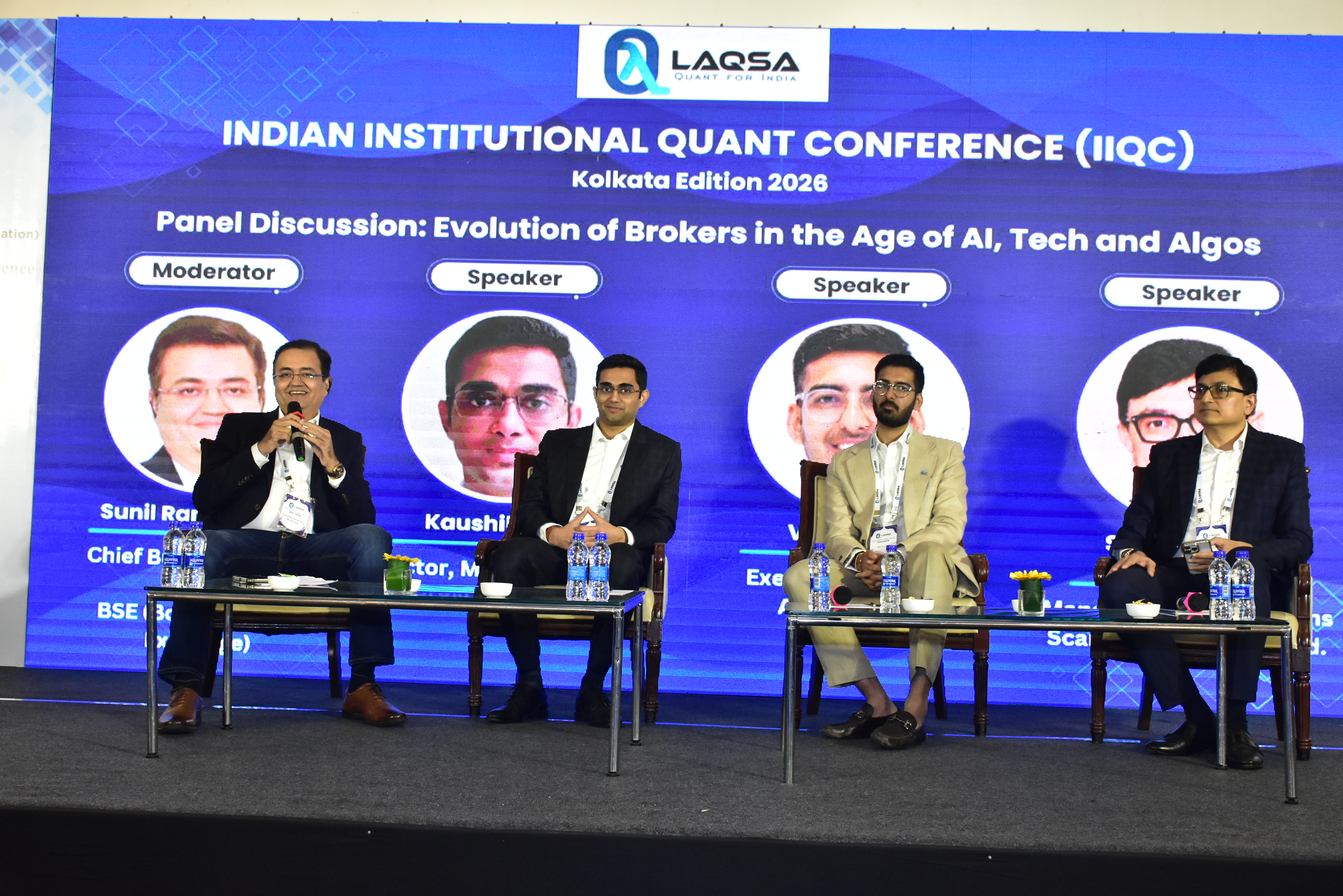
Technology took centre stage in the panel “Evolution of Brokers in the Age of AI, Tech and Algos”, moderated by Sunil Ramrakhiani, Chief Business Officer at BSE (Bombay Stock Exchange). Kaushik Daga (Director, Millennium Stock Broking Pvt. Ltd.) observed that low latency, once the whole conversation, is now merely the baseline, with technology increasingly used to build strategies that serve clients better.
Vatsal Jain (Executive Director, Ashika Group) cautioned that technology alone cannot set anyone apart without proper research behind it, noting that AI-driven analysis now lets research analysts cover far more stocks than ever before. Sandeep Jain, FCA (Managing Director, Trans Scan Securities Pvt. Ltd.) added that with clients drawn from every stratum of society, what worked a decade ago will not hold for long, making constant, AI-backed evolution essential.
Both conversations built on a theme set from the very start. In the welcome address, Pankaj noted that quant research in India is still at a nascent stage, with many holding only a vague idea of what quant is, which is why LAQSA is placing education and research at the heart of its work. Rishi invited the audience to contribute to quant research and share their feedback.
That emphasis on understanding ran through the morning. Moderating the panel on “Systematic F&O Strategies”, Anando Ghosh (Ex - BNP & Citibank Delta One Trader, Hong Kong) called for greater public understanding of systematic approaches. Vinayak Lahoti (Co-Founder, Levitas), Vivek Thebaria (Co-founder, MegaServe Technologies) and Pratik Mathran (Director, V Mathran & Co. Private Limited (VMPL)) discussed the rapid growth of systematic F&O in India, the value of strong data analysis and the case for long-term discipline.
In the fireside chat “Next Step in your Quant Journey - From Strategy to Structure”, Udit Sureka (EVP and Head - Products, Nuvama Asset Services) told Adityavikram Gupta (Managing Partner, Evolve) that running a fund is a very different discipline from managing money. The panel “The Future-Ready Family Office: Use of Quants and AI Along with Alternative Strategies”, moderated by Pawan Mehar (Founder - Unicorn Investment Managers and Director, LAQSA), then saw Vishal Jain (Head & CIO, Mars Ventures) and Harsh Chamria (Co-Founder & Managing Partner, Magma Ventures) explore process-driven decision-making and the many forms family offices take in India.
The day’s final panel, “Active vs Passive vs Systematic Active”, moderated by Mohit Beriwala (Founder, Shree Rama Managers LLP) with Maanvardhan Baid (Promoter & Director, Laurel Group) among the panellists, returned to first principles. Pankaj Gupta (Chief Investment Officer, Ratnabali Group) argued that a focused portfolio of 30 to 40 stocks improves the chances of alpha, cautioning against herd mentality, while Aditya Bhutra (Investment Manager, Avora SME Fund), drawing on his work with pension fund clients, explained why institutions that must keep paying pensions even when global equities fall need diversified options.
Sachin Pahuja (Passive Business Lead, ICICI Prudential AMC) concluded that active, passive and systematic active approaches all have a place, depending on the goals they are meant to serve. Shrey Sagar (Director of Business Development & Domestic Institutional Clients Group, Nuvama Asset) delivered the closing remarks.
Pankaj Mani, Co-Founder, LAQSA, said about the event, “As India’s not-for-profit quant association, LAQSA’s objective is to build a strong quantitative ecosystem and bring India on par with global standards. With data science and AI advancing rapidly, bridging the gap with the global ecosystem is critical for institutions and retail participants alike. Through educational programmes, webinars, research publications, and policy-focused discussions, which increasingly draw global institutions and policymakers, we are working to grow this community nationwide. After Mumbai, Bangalore, and Delhi, bringing our conference to Kolkata is part of our ongoing effort to rotate across key Indian cities.”
Rishi Kohli, Co-Founder, LAQSA, added, “Bringing IIQC to Kolkata for the first time was a natural next step for LAQSA following two years of successful events in Mumbai, Gurgaon, and Bangalore. As India’s first and only quant association, our goal is to unite people interested in quantitative and systematic approaches and related frameworks. With Kolkata’s professional community increasingly diving into quant, and strong encouragement from our local members and past speakers, the time was perfect to bring our educational and networking sessions here.”
If the day had a single message, it was that India’s quant journey will be built on understanding as much as on technology. In Kolkata, IIQC carried that message to a new region, its institutions and its next generation of quantitative minds, reaffirming LAQSA’s role as a catalyst for research-led, model-based thinking across India.