Artificial Intelligence and Amateur Photography: Democratization, Disruption, and the Future of Visual Creativity
BusinessRekha Nair08 Jun 2026
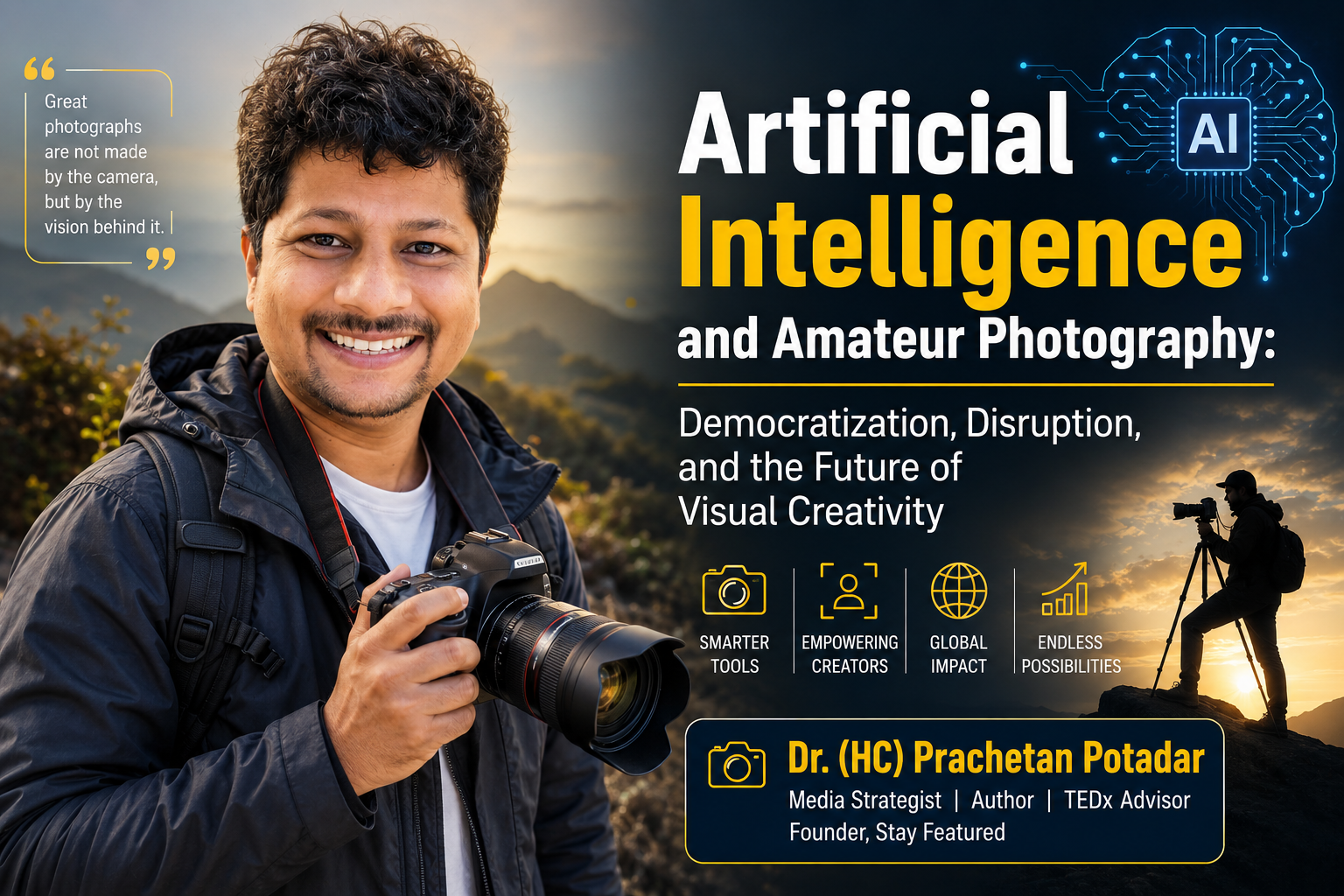
-Dr. (HC) Prachetan Potadar
The emergence of artificial intelligence (AI) in photography represents one of the most significant technological transformations since the transition from film to digital imaging. While debates surrounding AI often focus on concerns related to authenticity, artistic integrity, and professional displacement, its impact on amateur photography deserves equal scholarly attention. This article examines how AI is reshaping photographic practices, lowering technical barriers, democratizing access to creative tools, and redefining visual literacy. Drawing upon historical precedents, industry statistics, and lesser-known case studies, it argues that AI should be viewed not merely as an automation technology but as a catalyst for broader participation in visual storytelling. At the same time, the article highlights emerging challenges related to authenticity, algorithmic conformity, and the evolving role of human creativity in an increasingly automated visual ecosystem.
Introduction
Photography has historically evolved through technological disruption.
From the invention of the daguerreotype in 1839 to the widespread adoption of digital cameras in the late twentieth century, each major innovation has altered not only the mechanics of image creation but also society's understanding of visual representation.
Artificial intelligence now represents the latest chapter in this evolutionary trajectory.
Unlike previous technological advances that primarily enhanced hardware capabilities, AI fundamentally transforms how images are captured, processed, interpreted, and even generated.
For amateur photographers, the implications are particularly profound.
The accessibility of AI-powered editing software, computational photography, image enhancement tools, and generative visual systems has dramatically reduced the expertise traditionally required to produce aesthetically compelling images.
As a result, millions of individuals who previously lacked formal training or professional equipment now possess creative capabilities that were unimaginable only a decade ago.
This transformation raises a critical question:
Does AI diminish the value of photography by automating artistic processes, or does it expand creative opportunity by democratizing access to visual expression?
Historical Context: Technology and the Evolution of Photography
The anxiety surrounding AI is not unprecedented.
Throughout photographic history, technological advancements have frequently been met with skepticism.
The transition from film to digital photography during the 1990s serves as a particularly relevant example.
Many professional photographers argued that digital cameras would undermine artistic discipline and devalue traditional photographic skills. Similar concerns emerged with the rise of smartphone photography in the late 2000s.
Yet empirical evidence suggests otherwise.
Rather than reducing participation, technological innovations consistently expanded the photographic ecosystem.
According to industry estimates, more than 1.8 trillion photographs are now captured annually worldwide, compared to approximately 80 billion photographs in the year 2000. More than 92 percent of these images are produced using smartphones rather than dedicated cameras.
This remarkable growth demonstrates an important principle:
Technological accessibility tends to increase creative participation rather than diminish it.
Artificial intelligence appears to be accelerating this pattern.
The Democratization of Visual Creativity
One of the most significant contributions of AI to amateur photography is the democratization of technical expertise.
Historically, achieving professional-quality photographic results required extensive knowledge of exposure, lighting, composition, color correction, and post-production techniques.
Today, AI-assisted software performs many of these functions automatically.
Applications such as Adobe Lightroom, Google Photos, and smartphone camera systems utilize machine learning algorithms to optimize image quality, remove imperfections, improve lighting conditions, and enhance visual clarity.
Adobe has reported that AI-assisted workflows can reduce certain editing tasks by as much as 70–80 percent, enabling photographers to allocate more time toward creative exploration rather than technical correction.
This development is particularly important for amateur photographers.
Creativity often exists independently of technical proficiency.
By lowering operational barriers, AI allows individuals to focus on storytelling, experimentation, and artistic expression.
Consequently, the distinction between professional and amateur photography is increasingly defined by creative vision rather than technical capability alone.
Computational Photography: The Invisible Revolution
Many discussions of AI in photography focus on generative image systems while overlooking the transformative role of computational photography.
Computational photography refers to the use of software algorithms to enhance photographic output beyond the limitations of traditional camera hardware.
Google's Night Sight technology offers a compelling example.
Introduced as part of Google's Pixel smartphone ecosystem, Night Sight utilizes machine learning and multi-frame image processing to capture low-light photographs that rival results previously achievable only with expensive professional equipment.
This innovation illustrates a broader trend.
Rather than replacing photographers, AI often enhances human capability by overcoming physical limitations associated with cameras and environmental conditions.
Similar technologies now exist in portrait photography, dynamic range optimization, autofocus systems, image stabilization, and object recognition.
For amateur photographers, these developments effectively compress years of technical learning into automated processes accessible through consumer devices.
The Kodak Paradox: Lessons in Technological Resistance
One of the most overlooked case studies in discussions about technological disruption is the story of Eastman Kodak.
In 1975, Kodak engineer Steven Sasson developed one of the world's first digital cameras. Despite pioneering the technology, Kodak's leadership hesitated to fully embrace digital imaging due to concerns about cannibalizing its profitable film business.
The consequences are well documented.
Kodak, once controlling approximately 90 percent of the American film market and 85 percent of camera sales, eventually filed for bankruptcy protection in 2012.
The Kodak case illustrates a broader principle relevant to contemporary photography:
Technological disruption rarely disappears because established practitioners resist it.
Instead, innovation tends to reward adaptation while penalizing stagnation.
For photographers, the implication is clear.
The future of photography is unlikely to be determined by whether AI exists but by how effectively photographers integrate it into their creative practices.
Artificial Intelligence and Creative Authenticity
Despite its benefits, AI raises legitimate concerns regarding authenticity.
Photography has traditionally been associated with the documentation of reality.
The medium derives much of its cultural authority from its perceived connection to actual events and experiences.
AI challenges this assumption.
Advanced generative systems can now create highly realistic images depicting scenes, individuals, and events that never existed.
Similarly, AI-powered editing tools can alter photographs in ways that are increasingly difficult for viewers to detect.
This development introduces significant ethical considerations.
If photography becomes indistinguishable from synthetic image creation, traditional notions of visual truth may require reevaluation.
The issue extends beyond artistic practice into journalism, legal evidence, political communication, and public trust.
Consequently, scholars and industry professionals increasingly advocate for transparency standards, digital watermarking systems, and ethical guidelines governing AI-assisted image creation.
The Risk of Algorithmic Conformity
While AI expands creative opportunity, it may simultaneously introduce new forms of visual homogenization.
Machine learning systems are trained using large datasets containing existing images and aesthetic preferences.
As a result, AI-generated outputs often converge toward statistically popular visual styles.
This phenomenon can already be observed across social media platforms.
Dramatic skies.
Highly saturated colors.
Cinematic contrast.
Symmetrical compositions.
These aesthetic characteristics increasingly dominate AI-enhanced imagery.
Ironically, technologies designed to encourage creativity may unintentionally promote conformity.
For amateur photographers, this presents an important challenge.
As technical excellence becomes automated, originality becomes increasingly valuable.
Future success may depend less on mastering software and more on cultivating distinctive perspectives, narratives, and visual identities.
The Chess Analogy: Human–AI Collaboration
A useful analogy can be found outside photography.
In 1997, IBM's Deep Blue defeated world chess champion Garry Kasparov, prompting widespread speculation that human chess would become obsolete.
The opposite occurred.
Chess experienced significant growth, and players began using AI systems as training tools.
Today, elite chess competitors routinely collaborate with artificial intelligence to improve strategic understanding and performance.
Photography appears to be moving in a similar direction.
Rather than replacing photographers, AI is becoming a collaborative partner.
The most successful practitioners are likely to be those who combine technological proficiency with uniquely human capabilities such as emotional intelligence, cultural understanding, narrative construction, and creative intuition.
The future therefore belongs neither to humans nor machines independently.
It belongs to productive human–AI collaboration.
The Enduring Value of Human Vision
Despite rapid technological progress, artificial intelligence remains fundamentally different from human experience.
Algorithms process data.
Humans interpret meaning.
A machine can identify a sunset, but it cannot experience nostalgia.
A machine can generate a portrait, but it cannot understand personal relationships.
A machine can analyze composition, but it cannot feel wonder.
The most memorable photographs in history are rarely celebrated because of technical perfection alone.
They endure because they capture human experiences, emotions, and stories.
Consequently, while AI may transform photographic workflows, it cannot fully replicate the experiential dimension that underlies meaningful visual communication.
This distinction ensures that human creativity remains central to photography's future.
Conclusion
Artificial intelligence represents neither the death of photography nor its complete reinvention.
Rather, it constitutes the latest stage in a long history of technological evolution.
For amateur photographers, AI offers unprecedented opportunities to overcome technical limitations, enhance creative output, and participate in visual storytelling.
At the same time, it introduces important questions regarding authenticity, originality, and ethical responsibility.
Historical evidence suggests that technological innovation consistently expands creative participation.
The rise of AI is unlikely to be an exception.
The most significant impact of AI may not be the automation of photographic processes but the democratization of creative expression itself.
Ultimately, photography's future will not be determined solely by algorithms, software, or computational power.
It will be shaped by individuals who use these tools to communicate ideas, preserve memories, and tell stories that resonate with human experience.
As technology continues to evolve, the defining characteristic of great photography will remain unchanged:
not the sophistication of the tools employed, but the depth of vision behind them.
About the Author
Dr. (HC) Prachetan Potadar, popularly known by his pen name PenPaperPrachetan, is a media strategist, author, TEDx advisor, researcher, and founder of Stay Featured. His scholarly and professional work examines the intersections of technology, communication, leadership, innovation, media ecosystems, and human potential. Through evidence-based analysis and interdisciplinary storytelling, he explores how emerging technologies reshape industries, societies, and individual creativity.
A strong advocate of responsible technological adoption, Dr. Potadar believes that the greatest innovations are those that expand human capability while preserving the values that define meaningful human expression.